Thursday, November 10, 2011

Original Vocaloid Characters

Original Vocaloid Characters (called OC Vocaloids alternatively) are fanmade vocaloids who do not have a declared base of derivation, and are independent characters. They are usually written for storytelling purposes, and may or may not interact with other official or fanmade vocaloids. Some of them may go on to become UTAUloids. Only a very few amount of OC Vocaloids sing, and majority of them do not sing at all. Many of these are found in DeviantArt, though there are Japanese-made OCs.
Today let's get to know the first five characters:
Tia.pngTia (銀色 ティア Gin-iro Tia - Silver Tia) is the silver of the rainbow Vocaloids.She is very nice to every vocaloid she meets. She is Alpha's younger sister, and Leti's older sister.


Leti.pngLeti (パールホワイト レティ Paaruhowaito Reti - Pearl White Retty) is the pearl white of the rainbow Vocaloids.She is as nice as Tia, the Silver vocaloid. She is also shy. She is Alpha and Tia's younger sister.


Neon.pngNeon (光イエロ ネオン Kouierou Neon - Luminous Yellow Neon) is the bright yellow of the rainbow Vocaloids. She is as nice as Tia and Leti, twins of the rainbow vocaloids. Even though she is nice she is a typical tsundere and gets in fights with Ren, the red vocaloid often.


Miisha.pngMiisha (オレンジ ミーシャ Orenji Miishya - Orange Misha) is the orange of the rainbow Vocaloids. She is very sweet and childish. She is also the youngest, and a crybaby.


Ouroku.pngMonyako Ouroku (黄緑色黄緑もにゃ子 Ourokuiro Ouroku Monyako - Yellow-green Monyako) is the green of the rainbow Vocaloids. She's VERY energetic.

Tuesday, October 4, 2011

Personality and Ability of Kagamine Rin

Personality
As Rin's personality is decided by the fans, there have been many different interpretations of her. On top of that, many music videos place the characters in different situations and roles, but, as music videos are almost always fantasy even in the real world, these can be disregarded. However, there are recurring aspects of Rin's personality that can be pieced together with her most important songs and videos.
Rin is usually regarded as having something of a grudge against Miku, the more popular idol. She has been given the motto "OK, green is the enemy!" in numerous songs, "green" obviously referring to Miku. Her jealous side leads to her proclaiming things like how much cuter and nicer she is than Miku, as well as, "being cute doesn't get you anywhere, so I'm going to be tsun all the way!" Tsun is referring to the anime archetype tsundere, with tsun being the mean or cold exterior and dere being the nice interior of the character's nature.
Tsundere, despite Rin's use of it to make herself seem better than Miku, is actually a good term to describe her most of the time. She tends to treat the people she appreciates the most as if she doesn't like them at all, a very good example being her twin brother. This is probably due to the fact that, when it comes to showing appreciation, she gets very, very shy, as in the song "I Like You, I Love You" in which half of the lyrics are just her struggling to say the title, never quite getting all the way through until the very end.
However, rather than being a typical mean tsundere, she's actually more of the selfish, demanding type, and a few songs have a running gag of her demanding of her Master (whoever is using her software at the time) to give her snacks as a reward for singing, including one instance of her running him over with the Road Roller for skimping. In fact, in some videos, she's very quick to resort to running people (including her twin brother) over with the Road Roller when she is slighted, an indication of a quick temper.
Abilities
As a Vocaloid, Rin can sing songs and play music videos.
So far, she has successfully been able to Bend maps of Nautilus and Bend open and close the "program" of the mini Road Roller that the city gave her after her first week there.

Wednesday, September 28, 2011

Kagamine Rin

bf3oe9.pngKagamine Rin is one half of the second installment of Vocaloid2, also known as Kagamine Rin/Len. She, as well as Len, were created by Crypton Future Media as singing synthesizer application software that could be used to cover music as well as create original songs. Their shared software included two separate voice banks, using the same singer's voice samples, because there was demand for another male Vocaloid while they were still creating Rin. Because of this, Rin and Len are considered both to be mirror images and twins, but, due to the user-created nature of the characters in which the fans decide on their personalities and other information, Crypton backpedaled on marketing them explicitly as twins as was originally intended. It is, however, official that she and Len are 14 years old in regards to human age.
Several months after release, an update was created for the Kagamine software, improving the vocal quality of the two voice banks. However, their voice banks remain only Japanese, unlike some later releases.
Before the Kagamine product was released, however, there was a debate between the fan community on what her signature item would be (such as Hatsune Miku's signature leek item; Kagamine Len wasn't yet announced at this time). All of the suggestions didn't have a very strong impact, including an orange, a banana, or an onion—although, later, Rin would be given an orange and a yellow onion, while Len would get the banana.
However, a video emerged on Nico Nico Douga titled "Excuse me… I want to make a reservation of Kagamine Rin…" In the video, the Hatsune Miku software was used to have the character Hatsune Miku give a small speech, introducing herself, and then bringing up the topic of Rin.
A loose translation of what she said would be, "Miku has the leek, doesn't she? In short, a vegetable! Therefore, I think that Rin… should have a road roller! How's that?" Because of the unexpected proposal of the video, the idea soon caught on, and the Road Roller became a character item for both Kagamine twins. This video was also the history of the Road Roller's signature sound effect, "WRYYYYYYN", as Miku also suggested, as it sounds like Rin's name. The entire idea was based on the character Dio's (of Jojo's Bizarre Adventure) infamous time-stopping attack.

Tuesday, May 17, 2011

Usage for Music of Kagamine Rin/Len

Illu Vocaloid Kagamine RinLen Append.pngThe Vocal Character series were designed to be a set of vocals with particular characteristics about them. For the Kagamines, two Vocaloids with contrasting vocals for a very different result despite having the same voice provider. Since they are based on the same voice provider, both successfully harmonize with each other and therefore are often used in duets together. They also share a similar range to their predecessor Miku and can be used in together with Miku successfully.
Though they are voiced by the same provider, they have different pronunciations of words. Even by retuning the voice of either Kagamine to sound like the other, results are never identical, and only veteran Vocaloid fans can tell who is actually voicing the song. The reason is owed to the fact Len has a lisp-sound in his singing results that Rin does not. Len is the first male of the Vocaloid 2 era and the first male vocaloid able to hit high pitched notes. He lacks the ability to hit the lower notes less than Kaito, since he was produced as a young boy singer. Of the two voicebanks however, Len is often considered more difficult to work with than his counterpart, Rin.A particular noted weakness of Len's voicebank is that he is limited in his capabilities of matching masculine vocal tones, owed to his voice provider being female; he cannot produce a satisfactory low masculine vocal tone.
Originally Rin/Len Kagamine were regarded as a product for experienced users. Unlike Miku, they were not easy to utilize for beginners and were criticized that some voices in the original voicebanks were not clear and had pronunciation problems of the Japanese language. Their vowel sounds are choppy and overall lacked smoothness with a number of vowel related sounds being absent.

Saturday, May 7, 2011

Kagamine Rin/Len

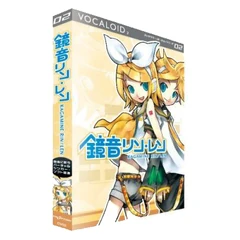
Ofclboxart cfm Kagamine RinLen.pngKagamine Rin & Len (鏡音リン ・レン) is the second product released on December 27, 2007, they are Vocaloid2 Character Vocal Series developed by Crypton Future Media Ltd. (CFM), male voice (Len) and female voice (Rin). Their family name was from the developing code combining Kagami (鏡, mirror) and Ne(音, sound).

Crypton Future Media intended to project a Vocaloid with low-teen girl's voice at first following Miku Hatsune, but there was a demand for a boy's voice, so Crypton Future Media hired a voice actress who can produce both sounds. The package included two voice banks: one for Rin and another for Len, both provided by the seiyū Asami Shimoda (下田 麻美 Shimoda Asami). Despite the double voice banks, the package was priced at the same price as Miku Hatsune.
At the time of recording in 2007, their names had not yet been decided. Their given names of Rin and Len were said to be based on "right" and "left" according to Asami Shimoda. She later confirmed in a interview after the Append release, the name itself was based on the names of Ken and Rin fromHokuto no Ken, the names were deprived from a discussion about names that were familiar from her childhood. According to Asami Shimoda, Len's voice was achieved by singing within her chest, while Rin's at the top of her head.

Tuesday, April 19, 2011

Usage for Music of Luka Megarine


The Vocal Character series were designed to be a set of vocals with particular charistics about them. Due to her bilingual coding, her "moody yet husky female voice" carries over into both languages and was designed to handle moodier genres like Jazz. Overall, Luka serves to bridge the gap between both languages and has proven to be her appeal as a vocaloid. She serves as an ideal vocaloid for English speaking users planning to use Japanese vocaloids and vice versa for users who are not so used to speaking English and planning on using English Vocaloids. Since she speaks both languages, Luka is able to partner with both Japanese and English vocaloids respectfully.
When installing Luka, it is important to pay attention to the release dates of Vocaloids you plan to install after her. Older and newer versions of theVocaloid 2 software engine can occasionally cause conflicts. Luka has both language engines, so she can cause conflicts between Vocaloids of either language. A user can fix this problem if it occurs simply by installing the Vocaloids in release date order, Luka is noted to be the most likely Vocaloid to produce this conflict.

Monday, April 11, 2011

Luka Megurine

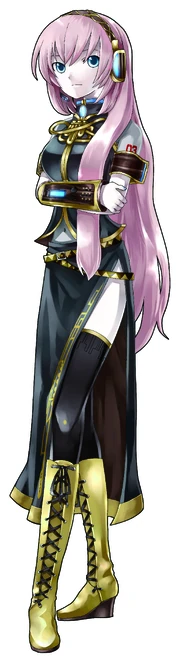
Lukaboxart.jpgReleased on January 30th, 2009, Megurine Luka (Japanese : 巡音ルカ Megurine Luka) is the third Vocaloid2 in Crypton'sVocaloid2 Character Vocal Series.Her surname combines Meguri (巡, circulate or around) and Ne (音, sound), while the name Luka invokes the homonymous Japanese words of "nagare" (流, flow) and "ka" (歌, song) or "ka" (香, scent); thus making "songs to all around the world as scent spreads." Yū Asakawa (浅川 悠) provided the voice for the "cool, somewhat mysterious" character.

Unlike its previous two characters, Crypton advertised Luka's 3GB vocal database as "Japanese/English bilingual" and chose her name to express its hope that she will transcend borders and cultural barriers. Luka was designed by the Japanese illustrator Kei, who had previously created the designs for Hatsune Miku and Kagamine Rin and Len. However, unlike previous mascots in the series, her costume is not based on a school uniform.
Only a few days after her release, many songs were produced. On the 70th Weekly Vocaloid Ranking (February 2, 2009), many of Luka's songs appeared in the Top 30, knocking the very popular "Miku Miku ni Shite Ageru" and songs produced by ryo (with the exception of "Melt") right out of the Top 30. "RIP=RELEASE" had taken the #1 spot, and had earned a total of 843,233 points, making it the song with the highest one-week score.

Friday, April 1, 2011

Kaito Cosplay Costume

After knowing some brief introduction about Kaito,today we will go on to know his cosplay costume.Now Vocaloid is very famous,I believe many of you can see it no matter in the Internet or advertisement,you are bound to familiar with some figures of them.Maybe some will also notice their costumes,shoes or some others,I don't know whether you noticed some things coming from Kaito.If you noticed or noticing that,what do you think about that?Do you like them?As follows,I will introduce his costume to you and hope you can like.


Vocaloid 2 Kaito Cosplay Costume
Vocaloid 2 Kaito cosplay costumeWell,this costume is just the one worn by Kaito,I think it seems cool.This costume is made of pleather,cotton,polyester and satin.The quality is good and it is also easy to clean because of the material.This costume comes with the long coat,pants and the scarf as the picture shows.If you would like to know the price of this costume,you can click the above title.Maybe you will think the costume is expensive after seeing the picture and knowing its material and contains.But actually when you see the price,you will think it is not expensive.Furthermore,we can tailor made this costume as your own size,it is free to tailor made for you.After getting your specific size,we will make a proper costume for you.For the question whether you can wear it well or not,you just needn't worry about that since we will make the best proper costume for you.

Friday, March 25, 2011

Usage for Music of Kaito

Until Gackpoid was released, Kaito and Leon were the only male voice banks and although Len was released his voice did not hit the same notes that they did. Since overall there are far less male vocaloids and he is the only Crypton male vocaloid that can reach his notes.
Kaito's vocal engine has been updated several times.He can utilize two kind of Vocaloid editors,VOCALOID 1.0 and VOCALOID 1.1, and they have different functions and features. There are many differences between ver1.0 and 1.1, and they sound differently even if they are edited in the same way. (Comparison of ver 1.0 and ver 1.1 without further editing Nico broadcast, Nicozon broadcast). The main differences are Singing Style and Portamento Timing.
To use his 1.0 version, users who are NOT using 1.1.2 version need to patch Vocaloid Ver1.1.2 update file for Kaito distributed on Crypton’s official page first before they use VOCALOID 1.0 editor. Without patching, an critical error will occur. 
He is fit to sing anything from hymns and children's songs to R & B and pop, though the style that he is best used for is singing pop ballads.

Friday, March 18, 2011

Kaito

KAITO is a Vocaloid created by Crypton Future Media. He utilizes the older Vocaloid engine developed by YAMAHA, the predecessor of Vocaloid2. The voice was supplied by a Japanese male singer Naoto Fūga (風雅 なおと, Fūga Naoto). The illustration was done by Takashi Kawasaki.. The product's name was invited from the public, and "KAITO" was selected from among applicants, which was the idea of Shu-tP.
He was created as a counterpart of Meiko and developed together. One of the reasons why his name "KAITO" was selected was that it would be easy for non-Japanese speakers to pronounce, and another reasons was that it looked fit to the name "MEIKO" when they were put next to next. On 24th July, 2003, an CCCD album "HISTORY OF LOGIC SYSTEM", which included a song using Japanese vocaloids commecially for the first time, was released. It was a duet song of "Ano Subarashii Ai wo Mou Ichido (That Wonderful Love Once More)" and it was covered by prototype version of Meiko and Kaito before their release. Meiko was released 1 year after this and Kaito followed her 2 years later.

Thursday, February 24, 2011

Hatsune Miku Costume-Vocaloid


I believe many people know Vocaloid or hear about it more or less since now there are too many things are relative to it.The ones who know it is bound to know Hatsune Miku,a very important role in Vocaloid.The reason that many people like Vocaloid is not only because of its characters,scenes,games and so on,but the cosplays that I think is very important point,which are worn by the characters,because those are all amazing.
But do you know how to cosplay them?Would you like to cosplay them?Would you like to own those cosplays?Now I will tell you about one cosplay costume.I hope those who like them or dislike them can be interested in Cosplay after reading this.
Vocaloid 2 Cosplay Hatsune Miku CostumeThe above costume you can see is one of Hatsune Miku’s costume.This costume is made of Satin + Pleather + Cotton + Polyester and it includes Blouse + Skirt + Accessories.You can see this costume is beautiful.It is just the same as the one in Vocaloid.But if you would like it,you can tell us and give us your specific size,then we will make it totally as your size.So when you get it,you can wear it perfectly and the costume you get is the same as the one in the pictures.After putting on this costume,you will become another special Hatsune Miku.If you would like to know more about this costume,you can click Vocaloid 2 Cosplay Hatsune Miku Costume which introduces specific information about it,or you can contact us,we will help you get out of the confusion.

Monday, January 24, 2011

Vocaloid 2


The first release based on the Vocaloid 2 engine came from PowerFX with Sweet Ann on June 29, 2007 whose boxart was based on a Frankenstein's monster.This was closely followed by Crypton two months later with the first of their "Character Vocal Series", Hatsune Miku, on August 31, 2007. Zero-G's first Vocaloid, Prima, came out on January 14, 2008 with voice of a Soprano opera singer. Internet Co., Ltd. also joined the Vocaloid development with their first Vocaloid Gackpoid on July 31, 2008, whose voice was provided by Japanese international singer Gackt. Gackpoid includes a new program, OPUS Express, for mixing vocal parts with accompaniment or phoneme data.AH Software later released their first Vocaloids on December 4, 2009 bringing the total of studios producing Vocaloids to five. As of the introduction of Bplats and Sony Music Entertainment Japan in late 2010, there are seven studios involved with the production and distribution of Vocaloids with two involved solely in English, four solely in Japanese and one in both languages for which the software is developed.
Crypton Future Media released the first dual Vocaloid Kagamine Len and Kagamine Rin, a Japanese male and female. On July 18, 2008, Crypton Future Media released the updated edition of Kagamine Rin and Len, named "act2".For a period of time, users who had bought the old version were allowed to get the new version for free. On June 18, 2008, beta demonstration songs using the new version were released on the company's official blog.The expansion disc is an entirely different software and does not affect the original Kagamine Rin/Len installation in any way, giving the user options to either use the old or new voice sets exclusively or combine their usage. Crypton Future Media have now retired the sale of their old Kagamine Vocaloid and it is now no longer possible to buy the software from them.This was also the very first Vocaloid update to be done for any Vocaloid.

Friday, January 21, 2011

Software history of Vocaloid

The Yamaha Corporation announced the Vocaloid technology for the first time at theGerman fair Musikmesse on March 5–9, 2003.The first Vocaloids, Leon and Lola, were released by the studio Zero-G on March 3, 2004, both of which were sold as a "Virtual Soul Vocalist". Leon and Lola made their first appearance at the NAMM Show on January 15, 2004.Leon and Lola were also demonstrated at the Zero-G Limited booth during Wired Nextfest and won the 2005 Electronic Musician Editor's Choice Award.Zero-G later released Miriam, with her voice provided by Miriam Stockley, in July 2004. Later that year, Crypton Future Media also released their first Vocaloid Meiko. Kaito was the only one sold using the Vocaloid 1.1 engine; the previous Vocaloids before him were sold as Vocaloid 1.0, which he was also supplied with. However, he needed the additional Vocaloid 1.1.2 patch to work on the Vocaloid 1.0 engine.A patch was later released to update all Vocaloid engines to Vocaloid 1.1.2, adding new features to the software, although there were differences between the output results of the engine.Even though Kaito and Meiko were Japanese and sung using Japanese phonetics, the main interface was in written using English for both English and Japanese Vocaloids.


Due to the success of placing a character on the box art of Meiko, the concept was carried over to her successor Kaito and later Vocaloids to encourage creativity, however neither Vocaloid's box art originally had the intention to represent that Vocaloid.Though Leon, Lola, Miriam and Meiko experienced good sales, Kaito was the only one who initially failed commercially, causing less demand for male voices for a while after Kaito's initial release.However, sales eventually picked up and Kaito later won the Nico Nico Douga second best seller award of 2008.After interest in Vocaloids grew, Zero-G began reselling their Vocaloid products again on their website, and were considering to update their box art to match current Vocaloid trends better.As well as an update for Leon and Lola's box art, Meiko and Kaito are also reported to be in discussion for an update.Several updated vocal expressions have already been recorded for Kaito.

Friday, January 14, 2011

Vocaloid

Vocaloid is a singing synthesizer application, with its signal processing part developed through a joint research project between the Pompeu Fabra University in Spain and the Yamaha Corporation, who backed the development financially—and later developed the software into the commercial product "Vocaloid".The software enables users to synthesize singing by typing inlyrics and melody. It uses synthesizing technology with specially recorded vocals of voice actors or singers. To create a song, the user must input the melody and lyrics. A piano roll type interface is used to input the melody and the lyrics can be entered on each note. The software can change the stress of the pronunciations, add effects such as vibrato, or change the dynamics and tone of the voice. Each Vocaloid is sold as "a singer in a box" designed to act as a replacement for an actual singer. The software is available in English and Japanese, although a Chinese version was produced for Sonika.
The software is intended for professional musicians as well as light computer music users and has so far sold on the idea that the only limits are the users' own skills.Japanese musical groupSupercell (Sony Music Entertainment Japan) have featured Vocaloid as vocals in their songs, and record labels in Japan also have released compilation albums featuring Vocaloids.